
The Essential Guide to Pressure Mattresses in Singapore: 2026 Caregiver Edition

Did you know that nearly 99% of severe Stage 3 and 4 pressure injuries in Singapore are community-acquired rather than developed in hospitals? Caring for a loved one with limited mobility is a heavy responsibility, and the constant fear of painful bedsores developing under our local heat and humidity only adds to that stress. You want them to rest comfortably, but the technical jargon surrounding pumps and mattress types often feels overwhelming. This guide will help you navigate the pressure mattress Singapore market so you can prevent skin breakdown and ensure lasting comfort. We will explain the functional differences between ripple and cell-type systems, show you how to manage the skin microclimate, and share how to access available support for your home care setup.
Table of Contents
The Science of Pressure Relief: Preventing Bedsores at Home
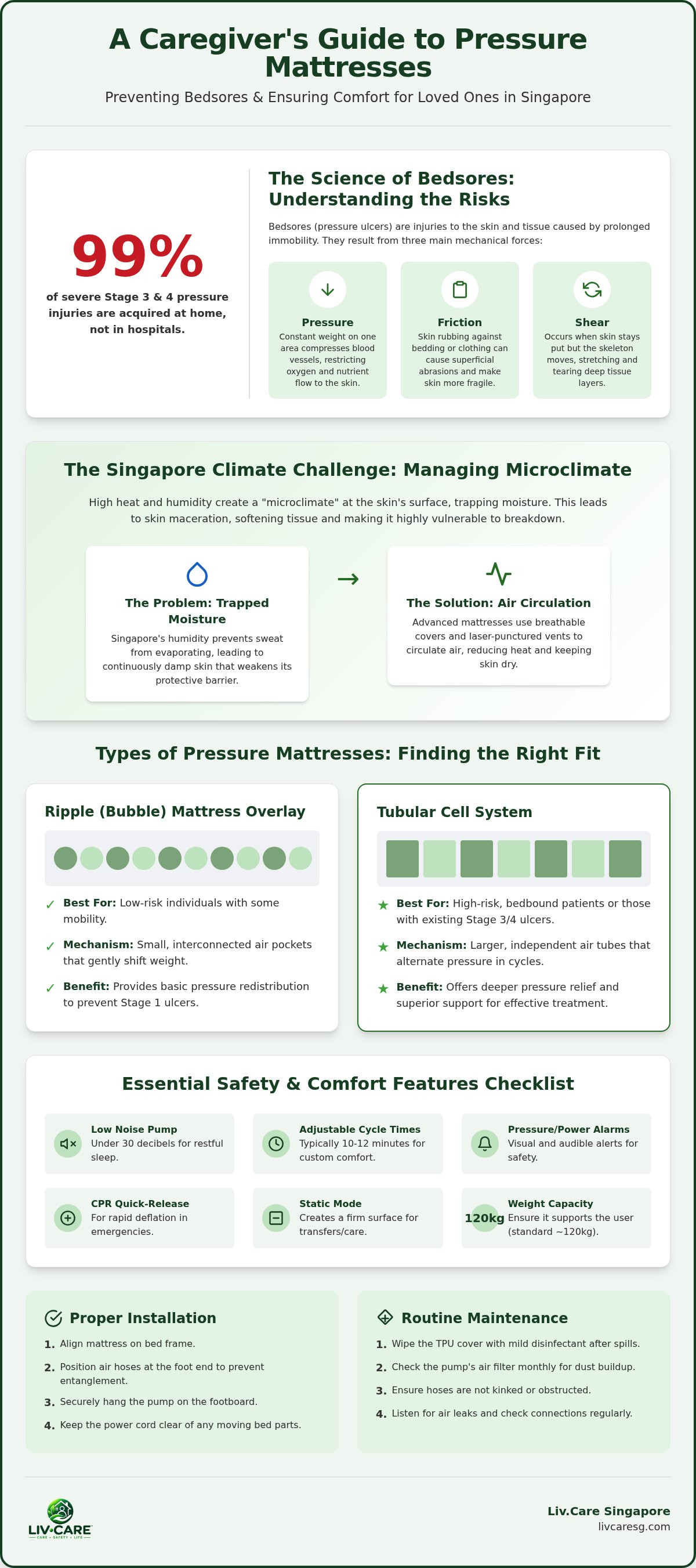
Pressure ulcers, commonly known as bedsores, are localized injuries to the skin or underlying tissue. For bedbound patients, these injuries represent a major clinical risk because prolonged immobility stops the natural distribution of weight. The Science of Pressure Relief involves managing three mechanical forces: constant pressure, friction, and shear. Pressure compresses blood vessels, while friction involves skin rubbing against bedding. Shear occurs when the skin stays stationary while the skeleton moves, stretching and tearing deep tissues. These wounds can be painful and lead to serious infections if left untreated.
A specialized pressure mattress Singapore families use addresses these risks through alternating air technology. By cycling air through different cells, the system mimics the natural movements of a healthy sleeper. It's a simple yet effective solution. This rhythmic inflation ensures no single area remains under constant load, allowing vital blood flow to return and nourish the skin cells. This process helps prevent the tissue death that leads to stage 1 and 2 ulcers.
Managing Heat and Humidity in the Singapore Climate
Our local humidity often leads to skin maceration, a condition where moisture softens tissue and makes it vulnerable. Microclimate is the specific combination of temperature and moisture levels at the point where the patient’s skin meets the mattress surface. High humidity levels can trap heat, which accelerates skin breakdown.
To combat this, advanced pressure mattress Singapore models include breathable TPU covers and laser-punctured air vents. These vents allow a tiny, continuous flow of air to circulate under the patient. This flow reduces heat buildup and keeps the skin dry and resilient. It's a vital feature for maintaining skin integrity in tropical environments.
Types of Pressure Mattresses: Finding the Right Fit
Choosing the right pressure mattress Singapore offers depends on the patient's specific risk level. Ripple mattresses, also called bubble types, are generally suitable for low-risk individuals who still have some mobility. These systems use small, interconnected air pockets to shift weight gently. In contrast, tubular cell systems are designed for high-risk patients. These feature larger, independent air tubes that provide deeper pressure relief and better support for those with existing stage 3 or 4 ulcers. While static foam mattresses offer basic comfort by redistributing weight across a contoured surface, active air systems are necessary for those who don't have the ability to reposition themselves at all. When evaluating options, prioritize pumps with noise levels below 30 decibels to ensure restful sleep. Check the weight capacity carefully; most standard models support up to 120kg, but bariatric versions are available if needed. Look for adjustable cycle times, typically between 10 to 12 minutes, to customize the relief pattern for the user's comfort.
Essential Safety Features for Home Care
Home care environments require specific safety mechanisms to protect the patient. A CPR quick-release valve is essential for rapid deflation during medical emergencies. Most advanced pumps include a static mode, providing a firm surface for feeding, dressing, or patient transfers. Visual and audible alarms are equally important, alerting you to low pressure or power failures on your pressure mattress Singapore setup. Preventing Bedsores at Home requires these reliable technical safeguards to maintain consistent care. If you're unsure which system fits your environment, browse our curated selection of pressure mattresses to find a suitable match for your needs.
Integrated Care: Installation and Long-Term Support
Setting up a pressure mattress Singapore families rely on requires careful alignment with an adjustable hospital bed. Place the mattress directly on the bed frame or atop the existing mattress, ensuring the air hoses are positioned at the foot end to prevent entanglement. Secure the pump firmly to the footboard using its integrated hooks and ensure the power cord is clear of the bed's moving parts. Routine maintenance is equally vital for long-term patient safety. Wipe down the TPU cover with a mild disinfectant after any spills and check the air filter behind the pump monthly to prevent dust buildup. While technical specs matter, a professional home care assessment Singapore is essential for high-risk patients. This ensures the equipment matches the specific mobility needs and home environment of your loved one. Selecting the right pressure mattress Singapore model is only the beginning of the care journey. You can learn more about clinical risks by reviewing the Types of Pressure Mattresses and the underlying causes of skin breakdown.
The Liv.Care Singapore Approach to Sustainable Caregiving
Caregiving shouldn't feel like a solo journey. Through our Care Membership, you gain access to ongoing technical support and regular equipment maintenance. This structured support system reduces anxiety by providing hands-on training for all household members, ensuring everyone knows how to adjust pump settings or react to alarms. We view pressure relief as one part of a comprehensive safety plan. For example, integrating toilet safety frames Singapore alongside your mattress setup creates a seamless environment for both rest and mobility. This holistic strategy ensures that every transition, from sleeping to moving about the home, is handled with confidence and care.
Securing Long-Term Comfort and Safety at Home
Selecting the right pressure mattress Singapore provides is about more than just buying equipment; it's about creating a clinical environment that respects your loved one's comfort. By understanding the mechanical forces behind skin breakdown and prioritizing features like low-noise pumps and breathable covers, you can effectively manage the risks of bedsores. Proper installation and consistent maintenance ensure these systems perform reliably year after year. At Liv.Care Singapore, we're here to guide you through every step of this journey. We offer personalized care coordination and a dedicated caregiver support membership to help you manage home health with confidence. You can also visit our showroom for hands-on equipment trials to find the perfect fit for your specific needs. Explore our curated range of pressure relief solutions to start building a safer home today. You've got this, and we're here to help.
Common Questions About Pressure Relief Systems
Do I need to leave the pressure mattress pump on 24/7?
Yes, the pump must stay on 24/7 while the patient is using the bed. These systems rely on continuous air cycles to redistribute weight and prevent tissue damage. If you turn the pump off, the mattress will eventually lose its support, leading to the patient resting directly on the hard frame. Modern pumps are built for longevity and consume very little electricity.
Can a pressure mattress be used on a regular home bed frame?
You can use a pressure mattress Singapore caregivers select on most standard bed frames, but it's not always ideal. A flat, firm base is required for the air cells to function correctly. We recommend using an adjustable hospital bed to prevent the mattress from sliding and to allow for safe positioning during feeding or rest without causing skin shear.
What is the difference between a ripple mattress and an air mattress?
A ripple mattress is a clinical tool specifically designed to prevent bedsores by alternating air pressure in bubble-like cells. Choosing a specialized pressure mattress Singapore model ensures you have an active system that cycles pressure to protect skin. Standard air mattresses for leisure don't provide this mechanical movement and aren't suitable for long-term bedbound patients who require constant pressure redistribution.
How do I clean a pressure mattress if a patient is incontinent?
Cleaning is straightforward because most medical-grade mattresses come with water-resistant TPU covers. If a patient is incontinent, wipe the cover down immediately using a damp cloth and mild disinfectant. Avoid using bleach or harsh alcohol-based cleaners that can damage the waterproof coating. Always ensure the surface is fully dry before replacing the bedsheets to maintain a healthy skin environment for the patient.

Comments